
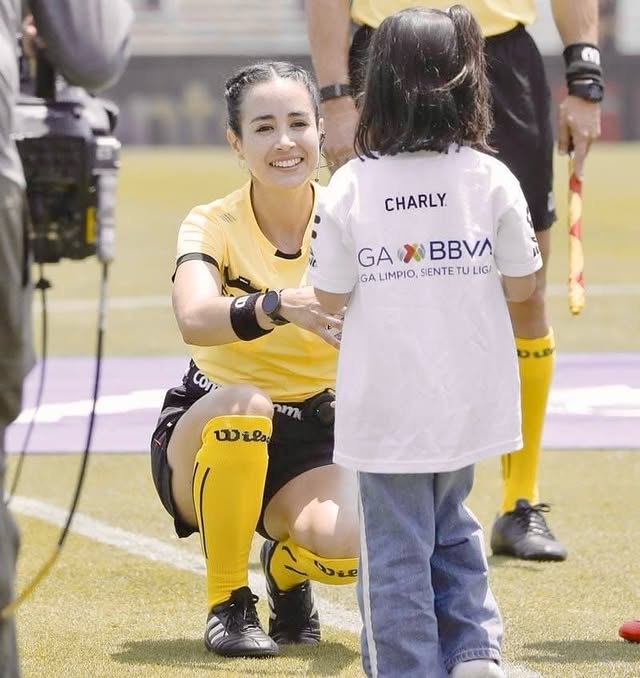
Credit: Instagram
Mexican referee Katia Itzel García Mendoza will make history on June 25 in Kansas City as the first Mexican woman to serve as center referee in a men’s FIFA World Cup match.
By JEFAS Magazine
Katia Itzel García Mendoza is set to make history on one of the biggest stages in global sports.
The Mexican referee has been appointed as the center referee for the FIFA World Cup match between Tunisia and the Netherlands on June 25 in Kansas City. With that assignment, García becomes the first Mexican woman to serve as the lead referee in a men’s World Cup match.
For Mexico, it is a historic moment in soccer. For women in sports, it is another reminder that leadership is not limited to the sidelines, the office, or the spaces where women have traditionally been allowed to stand. Sometimes, leadership is holding the whistle in the middle of the field, making decisions in front of the world.
García’s appointment is not a symbolic gesture. It is the result of years of preparation, discipline, pressure, and work in a profession where every decision is watched, questioned, slowed down, replayed, and judged.
At 33, García arrives at this World Cup with a career already marked by important milestones. She is from Mexico City, studied Political Science and Public Administration at the National Autonomous University of Mexico, and has held a FIFA badge since 2019. Her path in refereeing began in Mexico, where she moved through amateur soccer, professional divisions, youth tournaments, Liga MX Femenil, Liga de Expansión MX, and eventually major international assignments.
A Career Built One Match at a Time
Before the World Cup spotlight, García had already been opening doors in Mexican soccer.
In March 2024, she became the first woman in two decades to work as the center referee in a men’s Liga MX match. That assignment, Pachuca vs. Querétaro, placed her in a space where very few women had been allowed to lead. It was not just a line in a record book. It was a public test of authority, preparation, and calm under pressure.
García has also worked in international competitions, including the FIFA Women’s World Cup, youth tournaments, the Olympics, and the Gold Cup. Each assignment added to the experience that brought her to the 2026 World Cup.
Her work has been recognized beyond the field. In 2024, she received Mexico’s Premio Nacional de Deportes, one of the country’s top sports honors, in the judge-referee category. That recognition placed her among athletes and sports figures whose work has left a mark on Mexican sports.
Still, the World Cup appointment carries a different weight.
A men’s FIFA World Cup match is one of the most visible assignments in soccer. The referee is expected to control the game, manage the players, protect the rhythm of play, enforce the rules, and make decisions that can affect the course of a match. It is a job that demands physical preparation, emotional control, technical knowledge, and the ability to stand firm in difficult moments.
For García, that responsibility now comes with history attached to it.
More Than a Milestone
The phrase “making history” can sometimes sound simple, as if the achievement happened in one moment. But García’s story is not only about being named to one match.
It is about the years before the announcement. The early games. The training. The evaluations. The mistakes no one outside the profession sees. The criticism that comes with every call. The expectation to be exact, strong, composed, and fair, even when the environment is not always welcoming.
Women in sports often carry that extra weight. They are not only judged for the job they do; they are sometimes judged for entering the space at all.
García has faced that reality directly. Her career has unfolded in a sport where women referees are still treated as exceptions, even when they have the credentials, experience, and results to be there. She has also faced sexist comments and digital abuse, including threats connected to her work in international competition.
That part of the story matters, but it should not define her.
García’s rise is not a story of victimhood. It is a story of authority earned in difficult rooms and on difficult fields. It is a story about a woman who kept preparing until the appointment could no longer be seen as surprising. It had to be seen as earned.
A Mexican Woman at the Center of the Field
For many people watching, García’s presence in Kansas City will mean more than one game.
It will mean a Mexican woman standing at the center of a men’s World Cup match as the person responsible for leading it. It will mean young girls seeing a role that may not have looked possible before. It will mean women in sports, business, education, leadership, and community work recognizing something familiar: the quiet years of building before the public moment arrives.
That is why her appointment matters beyond soccer.
Representation does not solve every barrier. It does not erase the pressure or the resistance that women continue to face. But it changes what people can imagine. It widens the picture. It tells the next generation that authority can have a different face, a different voice, and a different story.
For Mexican and Latina women, García’s achievement carries a special kind of pride. She is not only representing a country. She is representing a generation of women who have entered spaces where they were not always expected and decided to stay anyway.
The Work Behind the Whistle
Refereeing is often noticed most when people disagree. A good referee has to live with that. The work requires confidence without ego, strength without losing control, and the ability to make decisions in seconds.
That kind of leadership is not far from what many women know in other fields.
Women who lead businesses, organizations, classrooms, teams, and families understand what it means to be watched closely. They know what it means to be questioned more than others. They know what it means to prepare, deliver, and still have to prove they belong.
García’s story speaks to that experience.
She has not built her career through noise. She has built it through consistency. Match by match, tournament by tournament, assignment by assignment, she has moved closer to the center of the global game.
Now, at the 2026 FIFA World Cup, she steps into that center with the whistle.
A Door Opens Wider For Katia Itzel García
Katia Itzel García’s appointment is already part of Mexican soccer history. But its meaning will likely continue long after the final whistle.
For aspiring referees, it shows that the path exists. For women in sports, it is another example of what can happen when talent is matched with preparation and opportunity. For Mexico, it is a moment of recognition on the world stage.
For JEFAS, it is also a story about a woman who turned discipline into authority.
García did not just reach the World Cup. She reached it as the person entrusted to lead a match.
And that is the part that makes this moment so powerful.
————————————————————————————————————————————————————————————-
Stay connected with stories that celebrate Latina leadership, business and community. Visit JEFASMagazine.com for inspiring features, resources and updates created for the next generation of JEFAS!
